In August 2026, a Brisbane commuter posted on r/brisbane after spotting an unexpected $2.50 default charge in their go card history from a broken platform reader back in March. When they clicked the online Report link inside their go card account, the system rejected the request on the spot because the trip was more than 120 days old.
Go Card Failed Tap Off: Translink's $2.50 and $25.80 Default Fares and the 120-Day Rule

With Queensland's flat 50-cent fares across South East Queensland, a single go card failed tap off multiplies the cost of a normal bus, train, tram, or ferry trip by five, and an unmatched tap on the Brisbane Airtrain triggers a $25.80 default fare. Here is what Translink's published rules say, which trips qualify for a balance adjustment, and how to submit a claim before the 120-day window closes.
The quick answer
- Most SEQ modes charge a $2.50 default fare. Under section 218M of the Transport Operations (Passenger Transport) Regulation 2018, Translink's Default fares page sets a $2.50 default (fixed) fare for Adult, Child, Senior, and Concession passengers across bus, train, G:link tram, and ferry services when a trip has no matching tap on or tap off.
- Airtrain is the $25.80 exception. If your unmatched tap involves the Brisbane Airport stations on Airtrain, the published default fare is $25.80 for Adult, Senior, and Concession cards ($2.50 for Child).
- You have 120 days to request a balance adjustment. Both the go card online portal and the Translink Ticketing Assistant enforce a 120-day limit from the date the charge occurred.
- System and service faults qualify, not forgotten taps. Translink's go card user guide states that default fares resulting from customer error are non-refundable, whereas faulty readers, station evacuations, and service cancellations or delays logged by the operator can be adjusted.
How much is a go card default fare in 2026?
Translink refers to an incomplete journey charge as either a default fare or a fixed fare. When you tap on at the start of a journey, the system records your entry location. When you tap off at the destination, it calculates the 50-cent flat fare (including up to three transfers within 60 minutes between legs).
If either tap is missing, the ticketing system cannot close the journey and applies the published default fare from Translink's Default fares table (as at 27 April 2026):
- Bus, G:link tram, and RiverCity ferry: $2.50 (Adult, Child, Senior, and Concession)
- Queensland Rail city network train: $2.50 (Adult, Child, Senior, and Concession)
- Southern Moreton Bay Islands (SMBI) ferry: $2.50 (Adult, Child, Senior, and Concession)
- Brisbane Airtrain: $25.80 for Adult, Senior, and Concession; $2.50 for Child
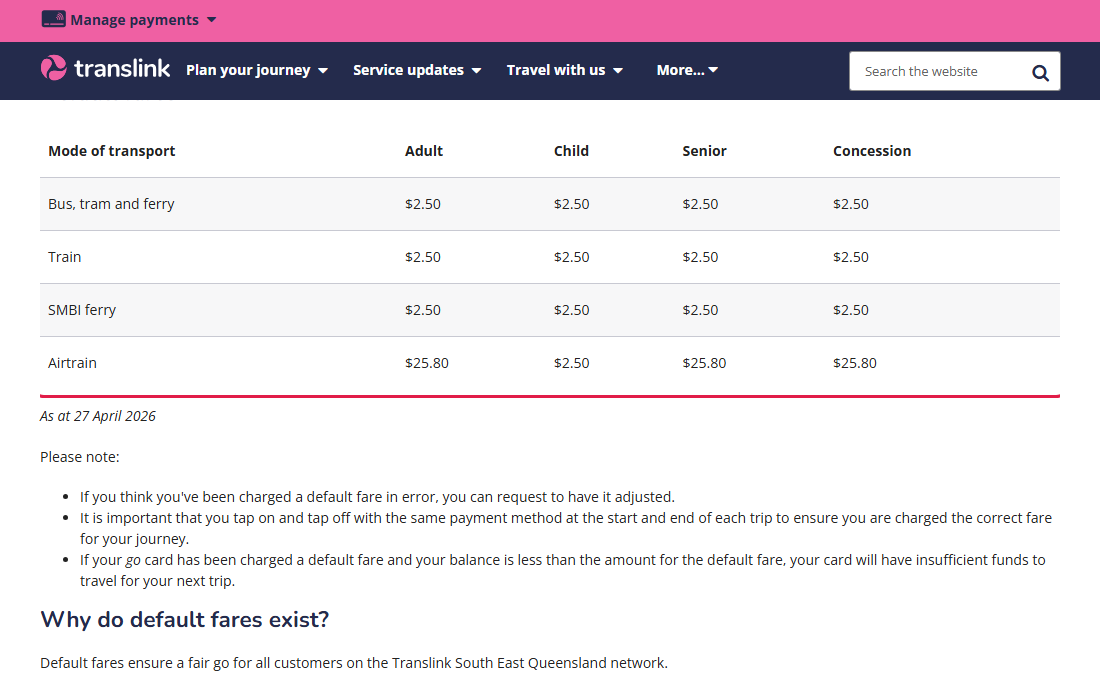
Translink notes on the same page that if a default fare reduces your go card balance below the minimum required for your next journey, the validator will show insufficient funds the next time you try to travel.
Why a go card tap off fails when you did everything right
In your go card online history, an incomplete journey normally appears with a Failed Touch Off or Unknown destination entry and a $2.50 deduction. Aside from simply walking past the reader, four technical and operational situations commonly trigger an unmatched tap:
- Out-of-order or frozen validators. A bus door reader that powers down mid-route or a station gate showing a red cross prevents you from recording your exit before the vehicle leaves.
- Double-beep declined reads in a crowd. On Translink's smart ticketing validators, a single beep with a green light and white tick means your tap succeeded, while a double beep with red lights and a white cross means the tap was declined. At busy interchanges like Roma Street, Central, Cultural Centre, or Helensvale, it is easy to hear a beep from the person ahead of you and keep walking without realising your card did not register.
- Wallet card clash. Holding a go card inside a phone case or wallet alongside contactless debit or credit cards can cause the reader to reject the tap or charge a contactless bank card instead of your go card.
- Abandoned journeys during rail or bus disruptions. If you tap on at a Queensland Rail station and leave the station after a train is cancelled or delayed, tapping off at the same station more than 20 minutes after tapping on records a trip rather than a free cancellation. (Tapping the same card at the same station between 10 seconds and 20 minutes after your initial tap cancels the tap at no charge.)
Step-by-step: how to request a go card balance adjustment within 120 days
When a system issue, faulty validator, or service disruption causes a $2.50 or $25.80 default fare on a registered go card, Translink processes the fix as a balance adjustment back onto your card rather than a bank transfer.
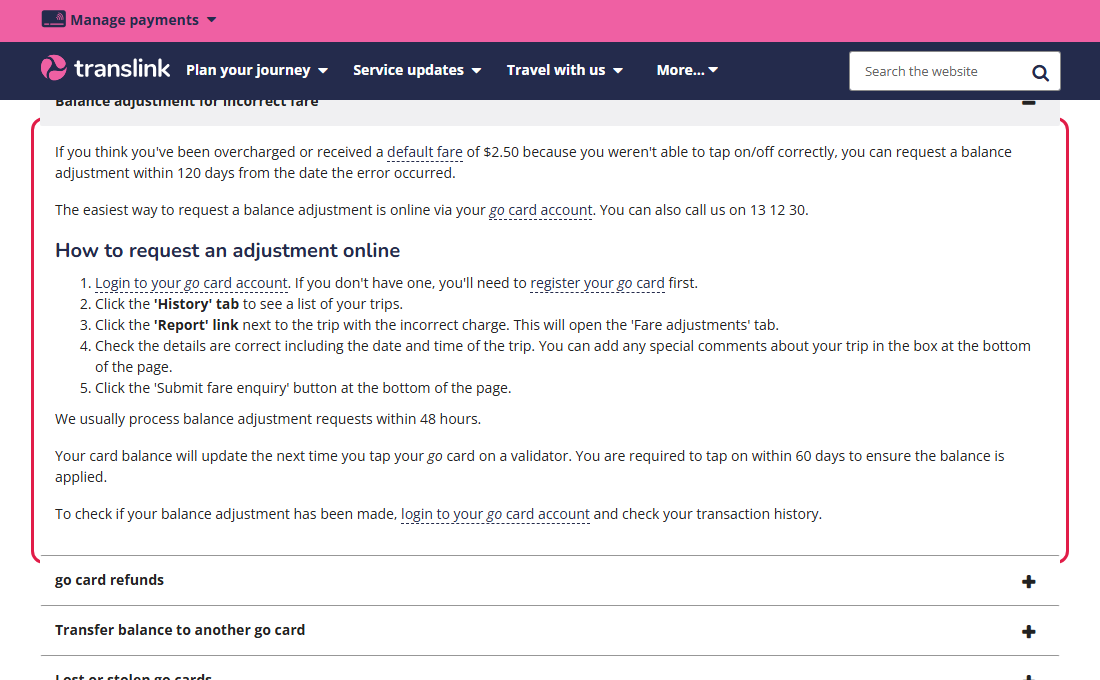
According to Translink's About go card page , follow these five steps within 120 days of the trip:
- Log in to your go card online account . If your go card is still unregistered, register the 16-digit card number first so your trip history is linked to your profile.
- Select the History tab from the top menu and filter the date range to locate the `$2.50` or `$25.80` default fare.
- Click the Report link on the right-hand side of that specific trip row. This opens the Fare adjustments form with the trip date and time pre-filled.
- Enter a short, factual note explaining what prevented the tap off (for example: "Tapped on Route 66 at RBWH at 4:40 pm; both rear door readers displayed out of service at Cultural Centre so I could not tap off").
- Click Submit fare enquiry.
How the credit lands on your go card (the 60-day tap rule)
Translink states that online balance adjustments are normally reviewed within 48 hours. Once approved, the credit does not show up immediately on your card's chip by itself:
- The adjustment sits queued in the system until the next time you tap on at a validator, which loads the credit onto your go card balance.
- You must tap on within 60 days of approval for the adjustment to be applied to your card.
- If the trip happened more than 120 days ago, the online Report button will reject the submission (as the r/brisbane commuter discovered). Your only option after day 120 is to call Translink directly on 13 12 30 and ask an operator whether they can review the historical log manually.
Scan your go card history before the 120-day window closes
Because go card statements list every leg individually, spotting a handful of $2.50 default charges buried inside months of 50-cent trips takes time. You can export your trip history from your go card account using our step-by-step history download guide and drop the file into FareClaim .
FareClaim is a free, volunteer-run community tool. It reads your go card export 100% locally inside your browser (your file is never uploaded to a server) and highlights every $2.50 and $25.80 default fare or missing tap off within the 120-day window so you can review what happened on that day and decide whether a system or service fault applies.
Scan your go card history free on FareClaim
Related guides
- Duplicate charges on go card or Translink contactless: how to spot double taps and claim within 120 days
- Go card balance transfer and $10 deposit refund: expired, lost or spare cards
- Go Card Refund & Translink Fare Adjustment: Which Form You Need (2026)
- Translink $2.50 Charge Instead of 50c? Why It Happens and How to Fix It
- Opal Default Fare: How Much You Pay in 2026 (& How to Claim)
FAQ
How much is the go card default fare when you fail to tap off?
On buses, trains, G:link trams, and ferries across South East Queensland, the published default fare is $2.50 for all card types (Adult, Child, Senior, and Concession). On the Brisbane Airtrain, the default fare is $25.80 for Adult, Senior, and Concession cards and $2.50 for Child cards.
Can I get a refund if I simply forgot to tap off my go card?
According to Translink's published go card user guide , default fares applied due to customer error are non-refundable. Balance adjustments are intended for trips where a faulty reader, station evacuation, system error, or logged service disruption prevented you from tapping on or off properly.
What is the time limit to dispute a go card default fare online?
You have 120 days from the date of the charge to submit a balance adjustment online via your go card account's History tab (or via the Translink Ticketing Assistant for contactless cards). Once approved, you must tap on within 60 days to load the credit onto your go card.
How do I cancel a go card tap on if my train is cancelled?
If you tap on at a train station and decide not to travel, tap the same go card off at the same station between 10 seconds and 20 minutes after your initial tap. The system cancels the tap with no charge. If more than 20 minutes have passed due to a delay, tap off and request a balance adjustment citing the delayed service.
Sources: Translink (Queensland Department of Transport and Main Roads), [Default fares](https://translink.com.au/tickets-and-fares/fares-and-zones/fixed-fare), [About go card](https://translink.com.au/tickets-and-fares/go-card/about-go-card), [Buy and refund tickets](https://translink.com.au/tickets-and-fares/buy-and-refund-tickets), and [go card user guide (May 2026)](https://translink.widen.net/s/chlw8bkq5j/go-card-user-guide), all checked 12 November 2026. Commuter report: [r/brisbane, "Gocard fair adjustment from more than 120 days ago"](https://www.reddit.com/r/brisbane/comments/1vgull0/gocard_fair_adjustment_from_more_than_120_days_ago/) (August 2026).
Disclaimer: FareClaim is an independent, volunteer-run community resource and is not affiliated with Transport for NSW, Translink (Queensland), Transport Victoria / Public Transport Victoria (PTV), or Transperth / Public Transport Authority of WA. Fare figures and refund rules are sourced from official operator publications on the date noted and provided as general consumer information only.
Written by
Jason Tan
Advocate & Volunteer, FareClaimPublic transport commuter advocate and volunteer at FareClaim, helping everyday passengers detect fare glitches, avoid penalty overcharges, and claim refunds.