

A Sydney commuter posted on r/sydney after finding "dozens upon dozens" of trips charged "at max rate" in their trip history: the Opal default fare, over and over. They'd been switching between their Apple Watch and the physical card it was linked to, whichever was handy, assuming the system saw them as the same thing. It doesn't. In their words, "some days a $7 day was costing me $30".
Another r/sydney post described a 501 bus where the reader seemed to lose track of the trip during a driver change, so one ride turned into two "No Tap Off" charges. Opal Customer Care gave back a $5.69 fare adjustment.
Both come down to that same charge. Here's what it costs on each mode, what caps it, and which ones you can actually get back.
The quick answer
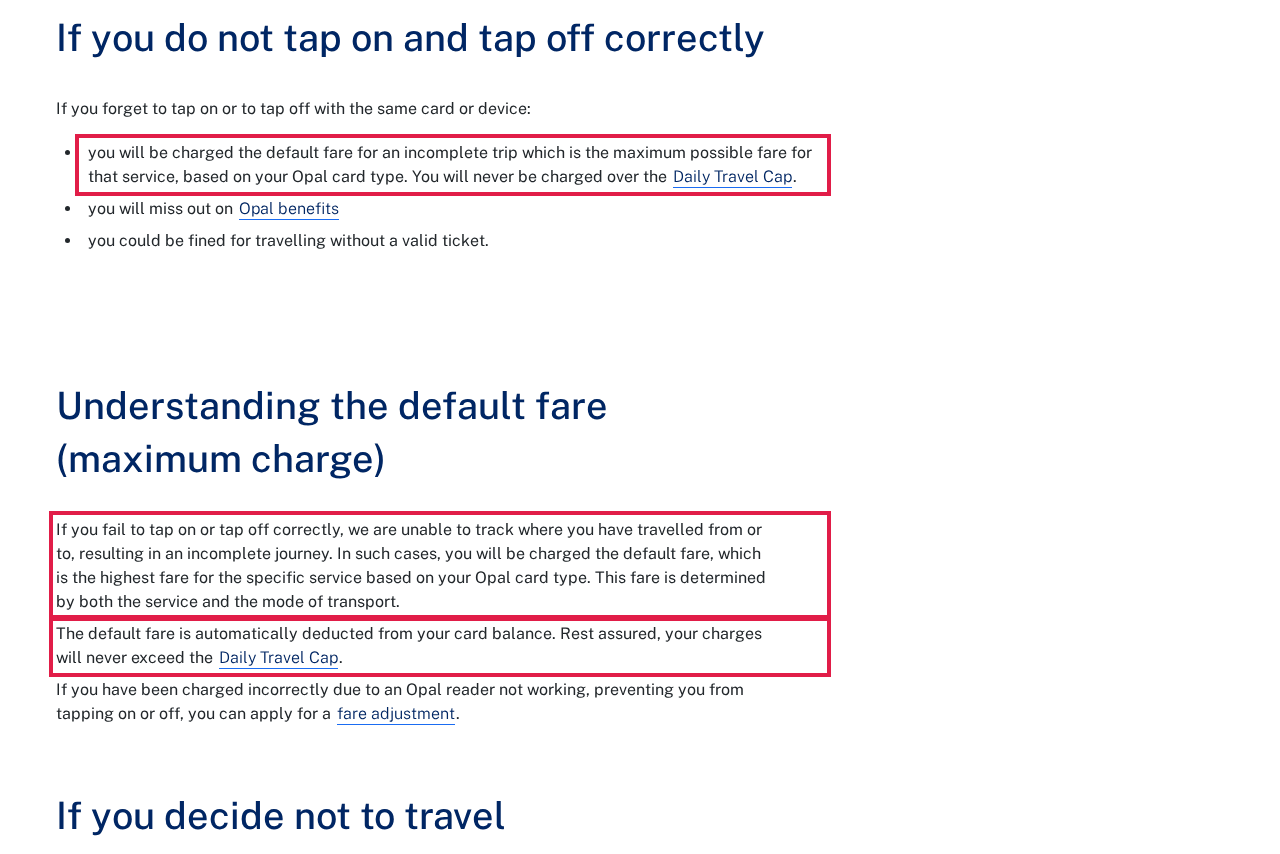
- What it is: if Opal can't match a tap on with a tap off on the same card or device, it charges the default fare: "the maximum possible fare for that service, based on your Opal card type" (TfNSW).
- How much (adult, worst case): train and metro up to $10.66 peak / $7.46 off-peak; bus and light rail up to $5.77 / $4.03; Sydney ferries up to $9.20. Concession is roughly half.
- The ceiling: you're never charged more than the Daily Travel Cap. For adults that's $19.30 Monday to Thursday, $9.65 Friday to Sunday and public holidays, and $50 a week (concession: $9.65 / $4.80 / $25). The Sydney Airport station access fee sits outside the caps.
- Can you get it back? Only if a reader fault, an evacuation or outage, or a service disruption caused it. A forgotten tap off isn't covered. Opal card claims have a 90-day window; contactless claims cover the past 80 days.
What is the Opal default fare?
Opal prices a trip by the distance between your tap on and tap off. If it only sees one half, it can't measure the distance, so it charges the most that service could have cost.
TfNSW's tapping on and tapping off page says the default fare is "the highest fare for the specific service based on your Opal card type", and that it is "determined by both the service and the mode of transport". On an Opal card it comes straight out of your balance.
You get a default fare when:
- you forget to tap off (or tap on)
- you tap on with one card or device and off with another, like the watch-and-card combo above
- a reader doesn't register your tap, or a broken or confused reader records the trip wrongly
- a disruption means you leave somewhere you can't tap off.
How much is the Opal default fare on each mode?
We couldn't find a separate list of default fares on transportnsw.info, but TfNSW does publish each mode's fare table, and a default fare can't be more than that mode's top band. These are the top bands from the Adult Opal fares page and the Concession Opal fares page , checked today:
- Metro and train (65+ km band): adult $10.66 peak, $7.46 off-peak. Concession $5.33 peak, $3.73 off-peak.
- Bus (8+ km band): adult $5.77 peak, $4.03 off-peak. Concession $2.88 peak, $2.01 off-peak.
- Light rail (8+ km band): adult $5.77 peak, $4.03 off-peak. Concession $2.88 peak, $2.01 off-peak.
- Sydney ferries (9+ km band): adult $9.20, concession $4.60. There's no off-peak price for Sydney ferries: TfNSW's 30% off-peak discount covers metro, train, bus and light rail.
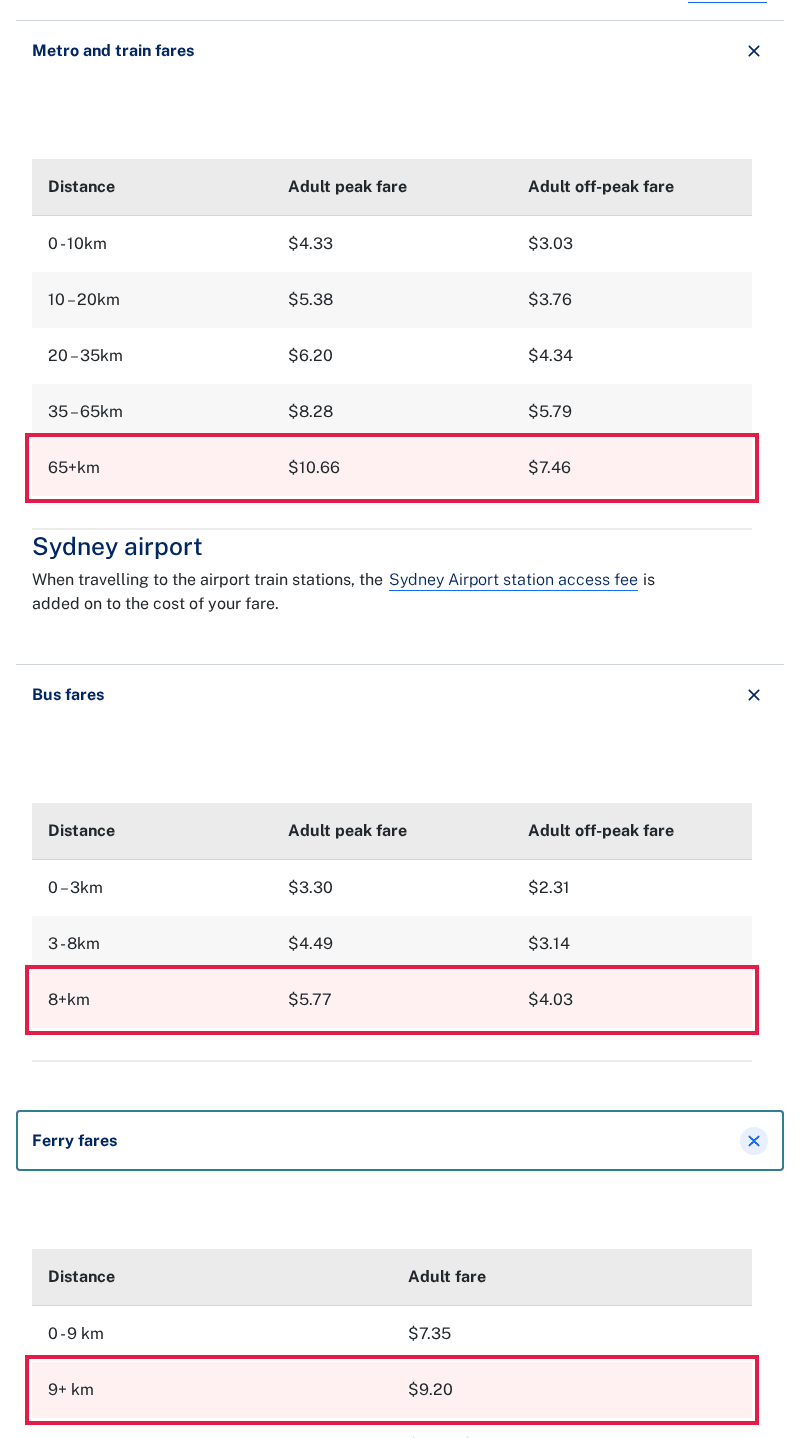
Because the default is the highest fare for that specific service, yours can be lower than those top bands. Check the trip in your history for the exact amount.
Watch out at the airport. The Sydney Airport station access fee is added on top of your train fare, and it sits outside the Daily and Weekly Travel Caps (it has its own weekly cap).
A worked example: what one bad day costs
Say you catch the train to work and back on a Tuesday, a 0–10 km trip each way at peak times.
- Normal day: $4.33 + $4.33 = $8.66.
- Both trips end up as default fares: at the top band that's up to $10.66 + $10.66 = $21.32. The Daily Travel Cap stops you at $19.30.
- The cost of that one bad day: up to $10.64 more than you should have paid.
On a bus the gap is smaller but it's there: a 3–8 km peak bus trip is $4.49, and a default fare can be up to $5.77.
Which default fares can you get back?
TfNSW's Opal refunds and fare adjustments page lists exactly three grounds for a fare adjustment. You were:
- charged an incorrect fare because of an issue with an Opal card reader
- unable to tap off because of an emergency evacuation, or a power or equipment outage
- charged a default fare because of a service disruption.
The 501 bus case fits the first one: a reader that lost track of the trip isn't your fault, and Opal Customer Care adjusted it.
What isn't covered:
- You forgot to tap off. That's not one of the three grounds, so don't expect it back.
- You mixed cards or devices. TfNSW's contactless reimbursements page says you can't get a refund if you tapped on or off incorrectly, didn't separate your cards or devices before tapping, or tapped off with a different card or device from the one you tapped on with. So the watch-and-card trips from the opening are the commuter's to wear.
Deadlines: Opal card fare adjustments must be requested within 90 days of the charge. Contactless reimbursements can only be requested for trips in the past 80 days, and TfNSW says to allow about 20 business days for those.
For the full claim walkthrough and a template for what to write, see our guide to getting an Opal refund when your train is cancelled .
How to avoid a default fare in the first place
- Changed your mind before travelling? Reverse your tap on for free. Tap the same card or device at the same station, wharf or stop within 30 minutes for metro, train and ferry, or 15 minutes for light rail. It doesn't work on a bus once it has left the stop.
- One card or device per trip, every trip. Your phone, your watch and the physical bank card behind them are three different things to an Opal reader.
- Take your Opal card out of your wallet. TfNSW lists a card "tucked in your wallet or next to other types of cards" as a reason a tap fails.
- On the F1 Manly ferry you don't need to tap off at all: it has one stop, so you're charged when you tap on.
- If a reader is dead or showing an error, note the time, place and bus route or station before you leave. That's your evidence for a reader-fault claim.
Check your history for default fares
- Download your Opal trip history. Our step-by-step guide to downloading your Opal, go card or myki history shows you where.
- Drop the file into FareClaim . It flags trips with no tap off, missed transfers and duplicate charges, and lines up the details you'll need.
- For each flagged trip, ask: was it a broken reader, an outage or evacuation, or a service disruption? If yes, claim it within the deadline.

FareClaim is free and volunteer-run. Your file is checked in your browser and never uploaded, there are no ads and no cut, and we're not affiliated with TfNSW. We don't lodge claims: you claim directly. It reads Opal card exports (plus go card and myki); contactless isn't supported yet.
Scan your Opal history free on FareClaim
Related guides
- Opal refund when your train is cancelled: what TfNSW will adjust
- How to download your Opal, go card or myki trip history
- Why your 50-cent Brisbane trip might be costing you more, and how to get it back
FAQ
How much is the Opal default fare?
It depends on the mode and your card type. For adults, the most a single default fare can be is the top band of each fare table: $10.66 peak on trains and metro, $5.77 peak on buses and light rail, and $9.20 on Sydney ferries.
Does the Daily Travel Cap apply to default fares?
Yes. TfNSW says your charges will never exceed the Daily Travel Cap: $19.30 for adults Monday to Thursday, and $9.65 on Fridays, weekends and public holidays. The weekly cap is $50. Concession caps are $9.65, $4.80 and $25.
Can I get a refund for an Opal default fare if I forgot to tap off?
No. TfNSW only adjusts fares caused by a faulty reader, an evacuation or outage, or a service disruption. A forgotten tap off isn't one of them.
Why was I charged two default fares for one trip?
Usually the system saw two incomplete trips: you used one card or device to tap on and another to tap off, or a reader failed to match your taps. A reader fault can be adjusted, so say what the reader did (and when and where) when you claim.
Sources: Transport for NSW, [Tapping on and tapping off](https://transportnsw.info/tickets-fares/fares/tapping-on-tapping-off), [Adult Opal fares](https://transportnsw.info/tickets-fares/fares/adult-opal-fares), [Concession Opal fares](https://transportnsw.info/tickets-fares/fares/concession-opal-fares), [Opal refunds and fare adjustments](https://transportnsw.info/tickets-fares/opal/manage-your-card/opal-refunds-fare-adjustments) and [Contactless reimbursements](https://transportnsw.info/tickets-fares/contactless-payments/contactless-reimbursements), all checked 8 October 2026. Commuter reports: r/sydney posts 1uck4gu and 1tumofu (both 2026).